· Product news
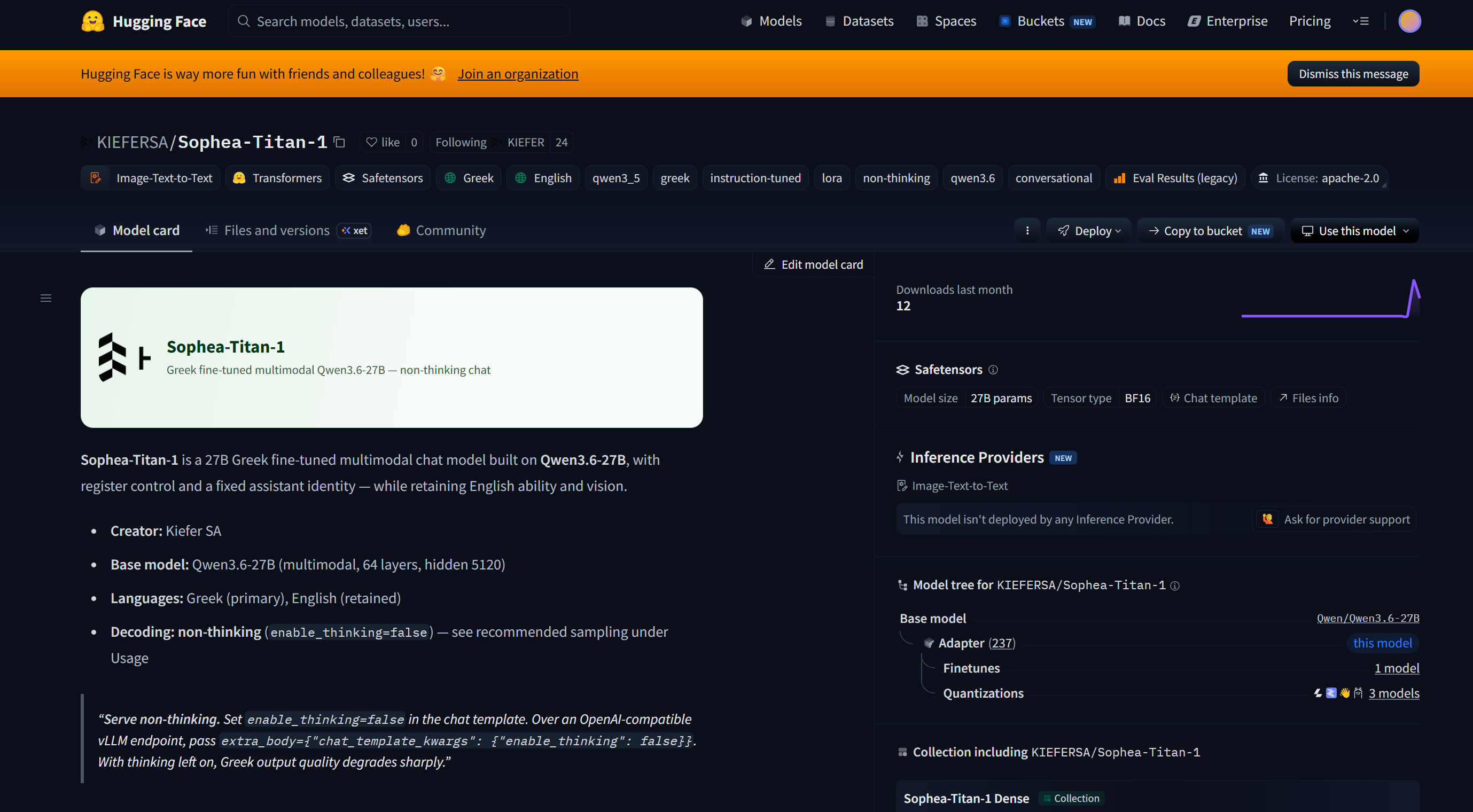
New open-weight release combines Greek-language specialization, English retention, vision capabilities, and deployment formats spanning data-center GPUs to Apple Silicon
ATHENS, Greece — 16 July 2026 — KIEFER SA has released Sophea-Titan-1, a 27-billion-parameter multimodal artificial intelligence model fine-tuned for Greek-language interaction and designed for deployment on infrastructure controlled by its users. The open-weight release gives enterprises, public institutions, researchers, and developers a new foundation for building Greek AI systems without depending exclusively on external, closed-model APIs.1
Sophea-Titan-1 combines text and image understanding with Greek-language specialization, retained English capability, formal-to-informal register control, and a consistent assistant identity. Its release represents a substantial new entry in Greece’s evolving open-model ecosystem, following earlier Greek-focused projects such as Meltemi and Llama-Krikri.1
Designed for Greek—Without Abandoning English or Vision
Greek remains underrepresented in the large datasets used to train many foundation models. Previous research on Greek LLMs has highlighted both the scarcity of high-quality Greek training data and the difficulty of improving a model’s Greek capabilities without degrading knowledge acquired from its base model.
Sophea-Titan-1 addresses this problem through Greek-focused supervised fine-tuning of a modern, dense, multimodal architecture. The resulting model is intended for general Greek conversation, Greek-knowledge question answering, bilingual workflows, image understanding, and applications requiring controlled communication style.1
KIEFER SA recommends operating Sophea-Titan-1 in non-thinking mode, with enable_thinking=false, because the published model card reports that enabling thinking can sharply reduce Greek output quality. This deployment requirement is documented alongside examples for vLLM, Transformers, and OpenAI-compatible endpoints.1
Published Evaluation Results
In KIEFER SA’s self-reported evaluation, Sophea-Titan-1 achieved a 0.7369 macro score across nine general Greek benchmarks. It scored 0.854 on GreekMMLU, 0.8783 across five English-retention benchmarks, and 0.714 overall on MMStar, a multimodal evaluation covering perception, reasoning, mathematics, and science-and-technology tasks.1
Closing the Distance to Frontier API Models
The published scorecard also compares Sophea-Titan-1 with API-access frontier models, including GPT-5.5, Claude Opus 4.8, Gemini 3.5, GLM-5.2, and MiniMax-M3. Sophea-Titan-1 does not surpass these systems overall, but its results show that a self-hostable 27B model can operate within a meaningful distance of much larger frontier services on selected evaluations. On GreekMMLU, Sophea-Titan-1 scored 0.854, compared with 0.898 for Gemini 3.5, 0.900 for Claude Opus 4.8, and 0.905 for GPT-5.5—a reported gap of approximately 4.4 to 5.1 percentage points. On the five-benchmark English macro, its 0.8783 score was within approximately 1.2 points of MiniMax-M3 and 1.4 points of GLM-5.2.1
These comparisons are directional rather than strictly like-for-like. The model card states that API systems were evaluated through letter-answer scoring, while local models used log-likelihood scoring, and model size, inference configuration, training data, and operating cost differ substantially.1 The strategic conclusion is therefore not that Sophea-Titan-1 has matched every frontier model, but that it delivers a competitive capability envelope while preserving the advantages of self-hosting, infrastructure control, customization, and predictable inference economics.
A Deployment Strategy Built Around GPU Economics
The strategic importance of Sophea-Titan-1 extends beyond benchmark performance. KIEFER SA has released several model formats intended to reduce the cost and complexity of self-hosted inference.
The full BF16 multimodal checkpoint requires approximately 54 GB of VRAM, according to the model card. A text-only FP8 edition is approximately 29 GB, while a text-only NVFP4 edition reduces the footprint to approximately 19 GB. GGUF and MLX conversions extend support to llama.cpp-compatible applications and Apple Silicon systems.1
A Building Block for Greek Sovereign AI
The release supports a broader sovereign-AI objective: enabling organizations to control where their models run, where sensitive data is processed, and how AI systems are integrated with local infrastructure.
For Greek enterprises and public institutions, self-hosted AI can reduce exposure to external platform dependencies, improve data-residency control, and create greater flexibility around model customization. It can also support a domestic technology stack spanning compute infrastructure, model engineering, enterprise applications, and specialized Greek datasets.
The defensibility of this strategy does not come from a single checkpoint alone. It comes from combining the model with proprietary domain data, agentic workflows, enterprise integrations, continuous evaluation, and optimized GPU infrastructure. Sophea-Titan-1 provides a foundation on which that wider ecosystem can be built.
Its value is also amplified by its role as a base for further task- and domain-specific tuning. Starting from a model that already combines strong Greek performance, retained English capability, multimodal understanding, and a 27B dense architecture can reduce the distance to production for specialized systems. Subject to appropriate data rights, safety controls, and independent evaluation, organizations could adapt it for sectors such as energy operations, industrial maintenance, financial document intelligence, public-administration workflows, maritime knowledge, customer service, or enterprise retrieval and agentic systems. Fine-tuning alone is not a guarantee of improved performance; each specialized release should be validated against domain-specific test sets and compared with retrieval-augmented or tool-using alternatives. Nevertheless, the model creates a reusable technical foundation from which KIEFER SA and its partners can develop higher-value vertical models without rebuilding Greek and multimodal capability from the beginning.
This creates a potential data and deployment moat: every validated domain adaptation, enterprise integration, evaluation set, and feedback loop can strengthen a specialized Sophea model family while increasing customer switching costs. The resulting asset is not merely a downloadable checkpoint, but a platform for developing proprietary vertical intelligence on infrastructure controlled by its operators.
“Sophea-Titan-1 is part of our commitment to building AI infrastructure that understands the Greek language and can operate under the control of the organizations that use it. Sovereign AI requires more than access to a model—it requires control of the compute, data, deployment architecture, and application layer.”
— Christos Petrocheilos, CEO, KIEFER SA
Availability
Sophea-Titan-1 is available now through the KIEFER SA repository on Hugging Face, together with deployment instructions and links to its quantized variants.1
The repository is marked Apache 2.0 on Hugging Face. Organizations should complete their own legal, security, and model-risk review before production deployment.1
The model has not been evaluated for safety-critical, legal, or medical decision-making and should not be represented as suitable for those purposes without additional domain-specific evaluation and controls.1